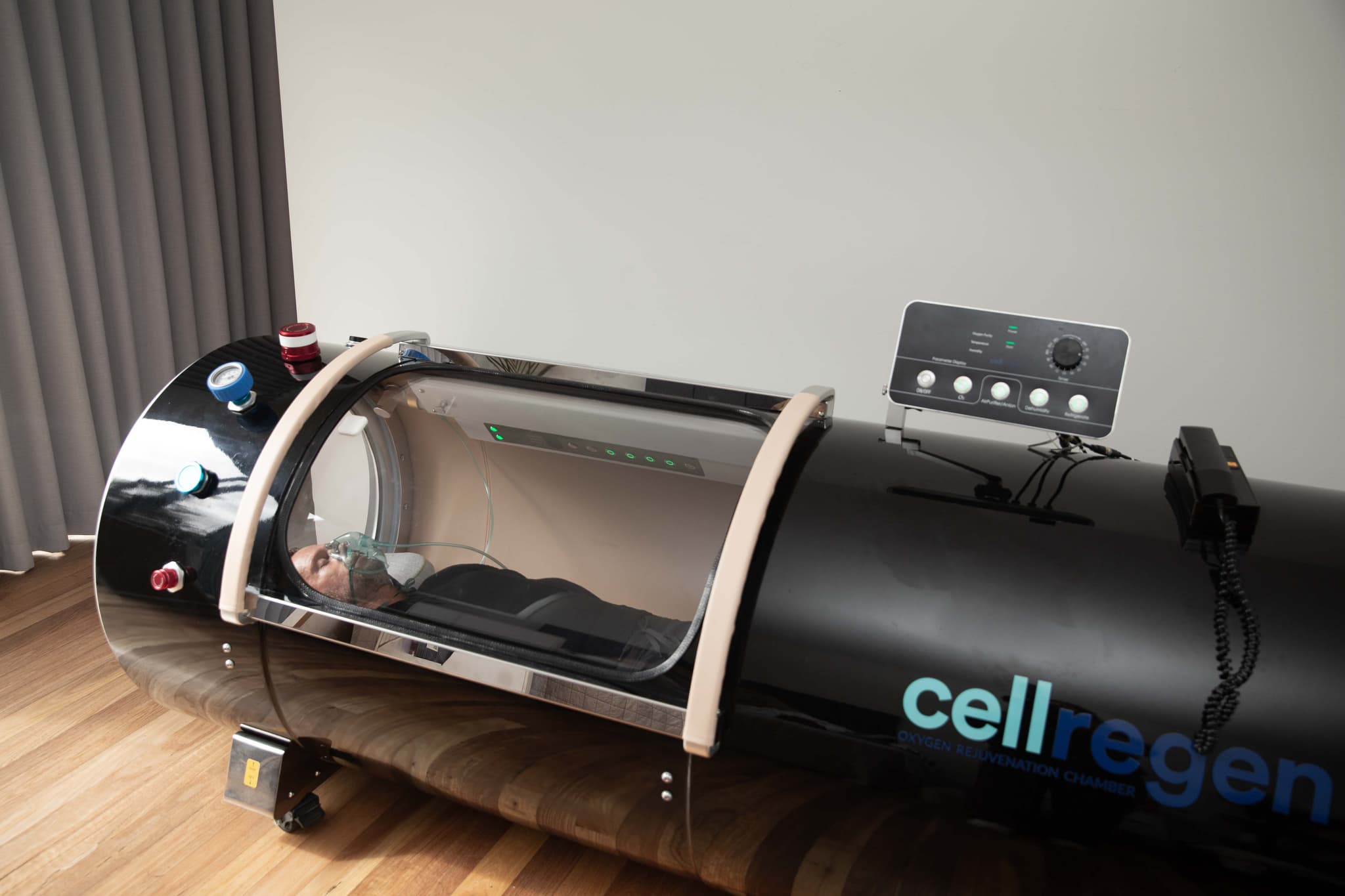
The brain is one of the most metabolically demanding organs in the human body.
Although it represents only a small percentage of our total body weight, it consumes roughly 20% of the body’s oxygen and energy at rest. That tells us something very important: brain function is deeply dependent on oxygen delivery, blood flow and cellular energy production.
When the brain is under stress — whether from concussion, traumatic brain injury, ageing, neurodegenerative change or other neurological conditions — several processes can become compromised.
Blood flow may be reduced. Inflammation can remain elevated. Mitochondria may struggle to produce energy efficiently. Damaged tissue may not receive optimal oxygenation. Sleep can become disrupted. And the brain’s ability to repair, reorganise and adapt may become less efficient.
This is where mild Hyperbaric Oxygen Therapy, or mHBOT, becomes an interesting area of supportive neurological research.
It is important to be very clear: mHBOT should not be presented as a cure or stand-alone treatment for neurological disease. Conditions such as autism spectrum disorder, Alzheimer’s disease, Parkinson’s disease, multiple sclerosis, concussion, traumatic brain injury and stroke require appropriate medical assessment and management.
What hyperbaric oxygen may offer is support for some of the underlying physiological processes involved in brain health.
More oxygen available to the brain
Under increased atmospheric pressure, oxygen dissolves more readily into the plasma — the liquid component of the blood.
This means oxygen availability is not limited only to what haemoglobin is carrying.
For areas of the brain where circulation or oxygen delivery may be compromised, increasing dissolved oxygen may temporarily improve the amount of oxygen reaching tissue.
This is one reason hyperbaric oxygen has attracted significant interest in areas such as concussion, traumatic brain injury, stroke recovery and cognitive decline.
A randomised controlled trial involving people with persistent symptoms following mild traumatic brain injury used 40 sessions at approximately 1.5 ATA, five days per week. Researchers reported improvements in post-concussion symptoms, memory, cognitive function, anxiety, depression, sleep and quality of life compared with the control period.
A more recent double-blind randomised trial also used 40 hyperbaric sessions in adults with persistent symptoms after brain injury and reported significantly greater improvement in neurobehavioural symptoms than sham treatment, as well as improvements in areas including sleep difficulties, anxiety and vestibular symptoms.
The science is still developing, but these studies help explain why neurological rehabilitation has become such an important area of hyperbaric research.
Neuroplasticity: helping the brain reorganise
For many years we viewed the adult brain as relatively fixed.
We now understand that the brain retains an extraordinary ability to adapt.
Neuroplasticity refers to the brain’s capacity to reorganise neural pathways, strengthen connections and recruit different networks in response to injury, learning and experience.
One important clinical study looked at people who had experienced a stroke 6 months to 3 years previously. Participants received 40 hyperbaric oxygen sessions over two months.
The researchers reported improvements in neurological function and quality of life together with changes in brain activity measured using SPECT imaging, suggesting that hyperbaric oxygen may stimulate neuroplasticity even long after the original neurological injury.
That concept is particularly interesting.
Brain recovery may not always end when the acute phase of an injury is over.
There may be areas of tissue that remain alive but metabolically compromised — sometimes described as “stunned” or chronically underactive brain tissue — which may potentially respond when oxygen availability and cellular metabolism improve.
Neurogenesis: can the brain create new neurons?
Neurogenesis is the process by which new neurons are generated from neural stem and progenitor cells.
It occurs primarily in specialised areas of the brain and has been studied extensively in relation to learning, memory, ageing and neurological injury.
Hyperbaric oxygen has demonstrated effects associated with neurogenesis in experimental research, including signalling pathways involved in cell survival, growth factors, stem/progenitor cells and neural repair. Reviews of HBOT in neurological conditions describe neuroplasticity, mitochondrial changes, inflammatory regulation and cellular repair among the proposed mechanisms.
But there is an important distinction:
We cannot currently say that a particular number of mild HBOT sessions will produce a defined amount of neurogenesis in a human brain.
That would go beyond the clinical evidence.
What we can say is that many neurological HBOT research protocols use a course of approximately 40 sessions, rather than expecting meaningful neurological adaptation from one or two exposures. Studies examining chronic stroke, post-concussion symptoms and brain injury commonly use this kind of repeated-treatment approach.
The biological response appears to be cumulative.
Angiogenesis: creating new blood-vessel networks
Another fascinating mechanism is angiogenesis.
Angiogenesis is the formation of new blood vessels.
This matters enormously to neurological tissue because neurons require continuous delivery of oxygen, glucose and nutrients.
In a study of people with chronic post-concussion syndrome following traumatic brain injury, researchers used brain perfusion MRI before and after HBOT. They reported significant increases in cerebral blood flow and blood volume together with improvements in cognitive measures.
The researchers proposed that hyperbaric oxygen may have stimulated cerebral angiogenesis, potentially improving blood supply to chronically injured brain tissue.
Again, this doesn’t mean mHBOT “treats” every brain condition.
It demonstrates something more fundamental:
oxygen and pressure can influence the environment in which neurological tissue functions and repairs.
Stem and progenitor cell mobilisation
Hyperbaric oxygen has also been shown to influence circulating stem and progenitor cells.
A landmark human study demonstrated that repeated HBOT could mobilise bone-marrow-derived stem/progenitor cells into the circulation through a nitric-oxide-related mechanism.
Further research found increases in circulating CD34+/CD45-dim progenitor cells following hyperbaric exposures, with responses changing according to oxygen dose and repeated sessions.
These cells are involved in tissue repair, vascular regeneration and healing signalling.
It is another example of why HBOT should not simply be viewed as “breathing extra oxygen.”
The physiological response extends far beyond the chamber session itself.
Mitochondria: the energy system behind brain function
Every thought, movement, memory and neural signal requires energy.
That energy is predominantly created by mitochondria.
And oxygen is fundamental to mitochondrial oxidative phosphorylation — the process responsible for generating much of the ATP used by our cells.
Research reviews examining HBOT and mitochondrial function describe effects on mitochondrial activity, oxidative signalling, antioxidant defence systems, HIF-1α, Nrf2 and other pathways involved in cellular adaptation. Repeated HBOT exposures appear biologically very different from a single exposure, with longer treatment courses associated with adaptive responses rather than simply an acute rise in oxygen.
For neurological health, this matters because mitochondrial dysfunction is increasingly being investigated across many neurological and neurodegenerative conditions.
Supporting cellular energy production may therefore be one of the most important ways hyperbaric oxygen influences brain physiology.
What about dementia and cognitive decline?
Hyperbaric oxygen is also being investigated in Alzheimer’s disease and mild cognitive impairment.
A 2024 systematic review and meta-analysis included 11 randomised controlled trials involving 847 participants with Alzheimer’s disease. The pooled findings reported improvements in cognitive measures including MMSE and ADAS-Cog as well as activities of daily living, although the authors emphasised the need for more rigorous research.
Another clinical study involving Alzheimer’s disease and amnestic mild cognitive impairment used daily hyperbaric oxygen treatments over 20 days and assessed cognition at follow-up points extending to six months.
This is encouraging research, but it should be interpreted appropriately.
HBOT is not established as a cure for Alzheimer’s disease or dementia.
Rather, researchers are exploring whether improving oxygen delivery, cerebral circulation, mitochondrial function and cellular signalling may support cognitive function in selected populations.
Autism requires a particularly careful conversation
Autism is another area where hyperbaric oxygen has generated significant interest — and where the evidence is mixed.
Some research has suggested physiological abnormalities in subsets of people with autism, including altered cerebral perfusion, inflammation, oxidative stress and mitochondrial dysfunction, providing theoretical reasons why HBOT has been investigated.
A multicentre randomised trial using 40 one-hour treatments at 1.3 ATA with 24% oxygen reported improvements in several behavioural and functional measures compared with a slightly pressurised control group.
More recently, a 2025 systematic review and meta-analysis of 17 studies involving 890 participants reported improvements across several autism-related outcomes, while also highlighting substantial heterogeneity and limitations in study quality. The authors concluded that better-quality trials are still required.
That is exactly how this subject should be presented:
interesting emerging research, plausible physiological mechanisms, but not an established treatment claim.
Sleep: one of the most overlooked parts of brain recovery
Sleep is when some of the most important neurological recovery processes occur.
Poor sleep affects memory, mood, hormonal balance, nervous-system regulation and brain energy metabolism.
Sleep disturbance is extremely common following concussion and traumatic brain injury.
Randomised HBOT research in military personnel with persistent post-concussion symptoms has reported improvements in several measures of perceived sleep quality compared with sham exposure, although not every objective sleep measurement improved.
Another clinical trial reported improvements in sleep alongside cognitive, psychological and post-concussion outcomes after a 40-session course.
Sleep may therefore be an important indirect pathway through which neurological recovery can be supported.
It is not about one mechanism
This is perhaps the most important message.
Neurological health is incredibly complex.
There is rarely one pathway involved.
Hyperbaric oxygen is interesting because it may influence several physiological systems simultaneously:
oxygen delivery, cerebral perfusion, mitochondrial energy production, inflammatory signalling, oxidative-stress adaptation, neuroplasticity, angiogenesis, stem/progenitor-cell mobilisation and sleep-related recovery.
That is why research has expanded across areas including:
concussion, traumatic brain injury, stroke recovery, mild cognitive impairment, Alzheimer’s disease, autism spectrum disorder and other neurological conditions.
But the correct question is not:
“Does hyperbaric oxygen cure neurological disease?”
The more scientifically responsible question is:
“Can improving oxygen availability and supporting the biological environment of the brain help optimise its capacity to function, adapt and repair?”
Increasingly, researchers are investigating exactly that.
For CellRegen, the objective is not to replace neurological or medical care.
It is to continue educating people about the extraordinary relationship between oxygen, pressure, cellular energy and brain physiology — and to encourage people to explore this rapidly developing field with appropriate professional guidance.
The brain uses enormous amounts of oxygen.
Perhaps it shouldn’t surprise us that changing the way oxygen reaches tissue can create such an interesting physiological response.
Gallery